
How a Water Heater Stores Energy Like a Battery
If you've spent time reading about renewable energy storage, you may have heard the word "battery" applied to things that aren't batteries at all: sand batteries, molten-salt batteries, ground batteries. It sounds like nonsense, but the thermal battery is a decades-old, well-understood idea, and there's a good chance one is already sitting in your basement or utility closet.
What is a thermal battery?
A thermal battery stores energy as heat instead of as electricity. While a lithium-ion battery holds energy in a chemical state that it converts back to electricity on demand, a thermal battery holds energy as warmth in something with mass (commonly water, ice, rock, or salt) and releases that heat later, when it's needed.
Storage matters for renewable energy because the most abundant sources, like solar and wind, are intermittent. Solar panels produce a lot of power when the sun is out and none when it isn't; wind turbines produce power when the wind blows and sit idle when it doesn't. Neither produces on a schedule that matches when people actually use electricity. Some way of holding onto that energy between when it's generated and when it's needed is what makes intermittent power usable around the clock, instead of only useful in the moment it's made.
Look at the graph below of electricity demand on the grid over a single day. Demand starts low overnight, while most people are asleep. It climbs through the morning as people wake up, get ready, and head to work. Then, in the late morning and early afternoon, as solar panels across the grid ramp up production, the net demand for grid electricity actually drops, even though people are using just as much power as before. Solar is simply covering more of it. That dip holds through the afternoon, then reverses in the early evening: the sun starts to set right around the time everyone gets home, turns on air conditioning, plugs in devices, and starts cooking dinner. Demand spikes sharply right as solar production is falling off.
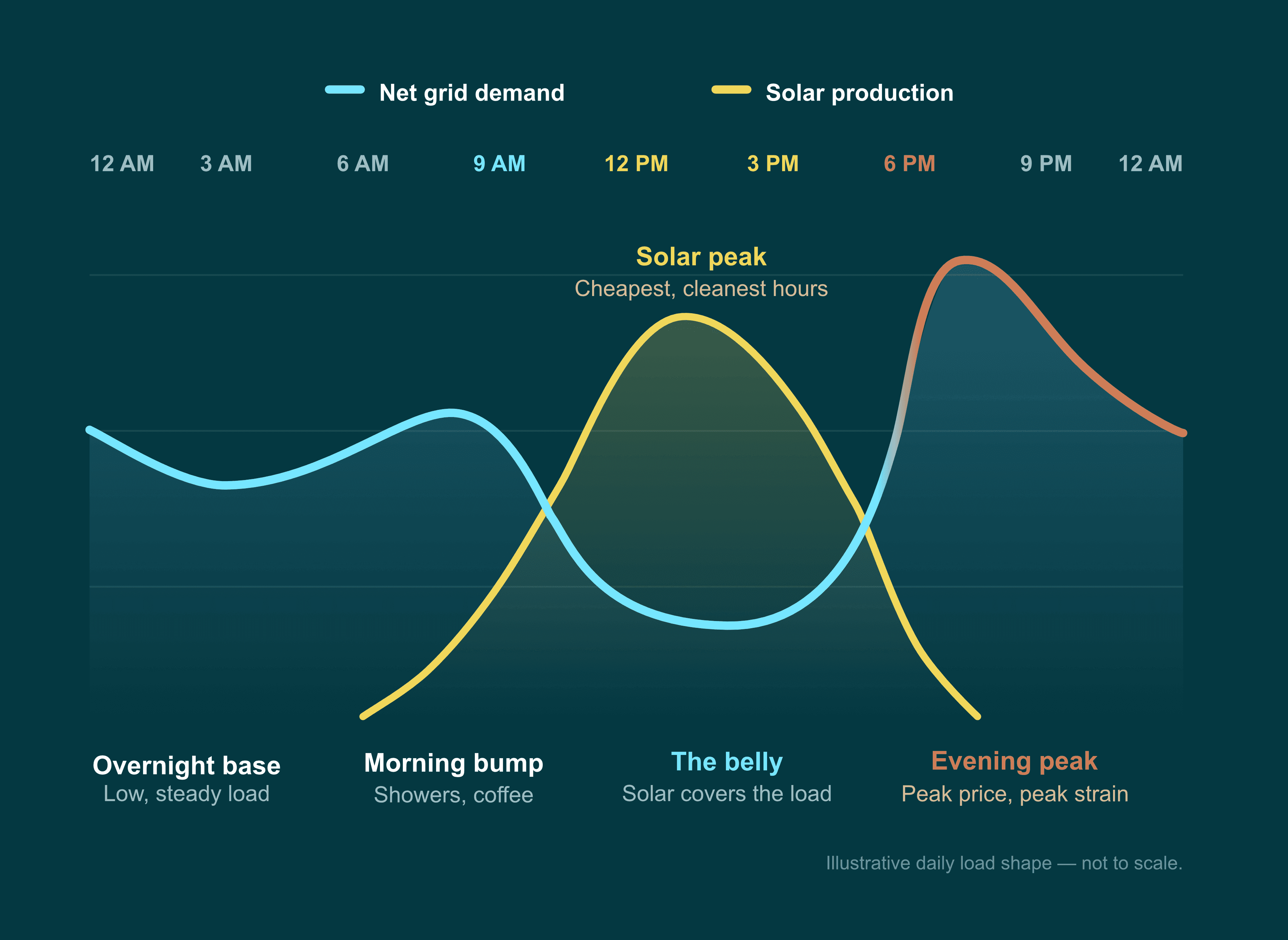
This concept is sometimes called the “duck curve” based on the shape drawn by the difference between demand and production.
This graph is sometimes called the "duck curve." If you squint, the line traces the shape of a duck's body: the morning ramp-up is the tail, the midday dip is the belly, and the sharp evening spike is the neck and head.
A thermal battery helps flatten the duck curve. It soaks up cheap, abundant energy during the belly, and holds onto it as heat, so it doesn't need to draw more power from the grid during the neck. Multiply that across enough homes, and the whole curve gets shorter and gentler, and gets the most out of renewable sources.
How can a water heater be a thermal battery?
Water heaters are already storing energy as heat. That's the entire premise of a tank: it holds gallons and gallons of hot water, ready whenever you turn on the tap. The question is whether it can store that heat strategically, shifting when it heats to match when energy is cheapest or cleanest, rather than only reacting to the temperature in the tank at a given moment.
To do that well, a water heater needs several things most tanks on the market today don't have:
A mixing valve. If a tank is going to store water hotter than what comes out of your tap—which is how you pack more usable energy into the same size tank—something needs to blend that hot water down to a safe temperature before it reaches you. A mixing valve does that automatically, so a thermal battery can run hotter internally without ever sending scalding water to your faucets.
Excellent insulation. Heat that leaks out of the tank between now and when you need it is heat you paid for and didn't get to use. Good insulation is what makes it worth heating water hours before you'll actually use it.
Advanced corrosion protection. Because a thermal battery reaches elevated temperatures while charging, any tank being used as a thermal battery should have advanced corrosion protection, like an electric anode, which uses a small electric current to prevent rust nearly indefinitely.
Predictive heating. This is the piece that turns a water heater from an ordinary, passive tank into an active thermal battery. With access to weather, grid, and solar data, the water heater can forecast the best windows to heat: ahead of a utility peak, when your solar panels are producing more than your home is using, or when your electricity is cheaper. It's making a decision about when to store energy, not just whether to.
How thermal batteries help homeowners
If you have rooftop solar, a predictive water heater can shift its heating to the middle of the day, when your panels are producing at their peak. That means more of your own solar energy gets used by your household instead of exported back to the grid, often at a lower rate than what you paid for it.
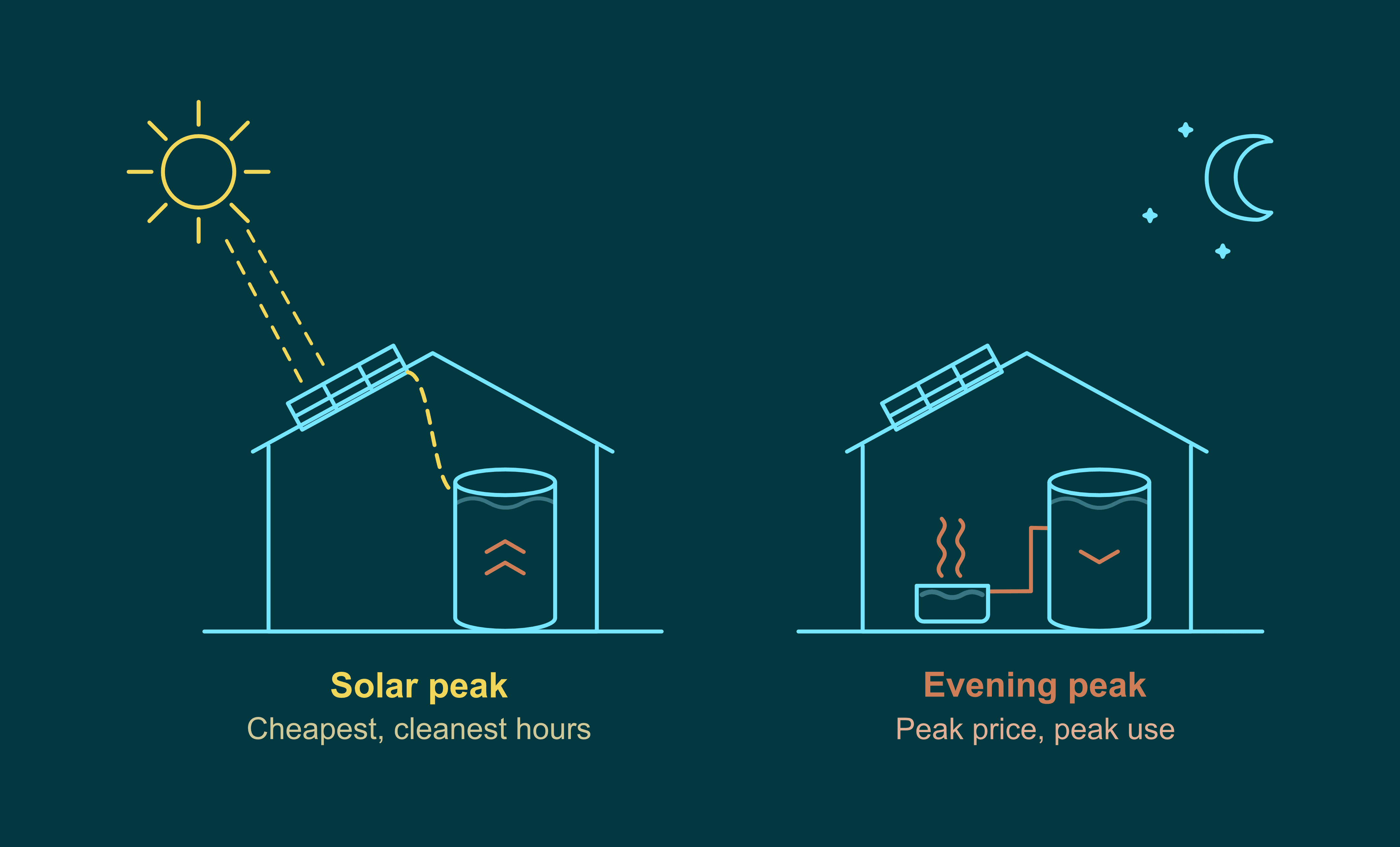
Solar Sync warms your household water during the day, when rooftop solar is producing surplus electricity, and keeps the water warm for use through the night.
If you have time-of-use rates, where electricity costs more during certain hours, a thermal battery can heat water when rates are low, and coast on stored heat when rates are high. It's the same water heater doing the same job, on a smarter schedule.
Either way, you save money without changing your habits. You don’t need to shower in the middle of the day or run the dishwasher at midnight. The water heater handles the timing. You just turn on the tap and get the same hot water as always.
How thermal batteries help the electric grid
Zoom out from any one household, and the same shifting behavior that saves you money also helps flatten the duck curve at a grid level. Every water heater that moves its heating load from the evening peak to an off-peak window is a little less strain on the grid at exactly the moment strain is most expensive and most carbon-intensive to cover. No single water heater moves the needle much. Thousands of them, heating on a coordinated, predictive schedule, can be grid-scale infrastructure.
Reservoir is designed to be a thermal battery
Our mission is to make home electrification easy, affordable, and awesome, starting with a heat pump water heater that gets water hot before you need it, conserves energy when you don’t, and protects your home from water damage before it happens.
Reservoir was designed from the start to work as a thermal battery. Its core architecture was designed around excellent insulation, advanced corrosion protection, and machine learning, and every Reservoir is installed with a mixing valve.
If you're curious what that could look like for your home, with your roof, your rates, and your household's habits, take our 5-minute Virtual Assessment to get started.