
Electric Resistance vs. Heat Pump Water Heater: Should You Upgrade Now?

Most people don't think about their water heater until the day they turn on the tap and only cold water comes out. They replace it with whatever can be installed the fastest (understandable, if they have to wash dishes and bathe kids) on a purchase that costs thousands of dollars upfront and thousands more over its lifetime. It’s often worth considering an upgrade sooner.
A heat pump water heater (HPWH) does the same job as your existing electric tank, using the same electrical circuit, for a fraction of the monthly cost. The tradeoff is a higher price tag upfront. Whether that tradeoff is worth making on a unit that still works, rather than waiting for a forced replacement, comes down to math that's specific to your home: your current electric rate, how much hot water your household uses, and how much you'd pay to finance the switch.
Electric resistance water heater | Reservoir | Other heat pump water heaters | |
|---|---|---|---|
How it heats water | Submerged heating elements, like a giant kettle | Pulls heat from surrounding air using a refrigerant cycle, with electric resistance elements to supplement | Pulls heat from surrounding air using a refrigerant cycle, sometimes with electric resistance elements to supplement |
Efficiency (UEF) | 0.88-0.95 | 3.53 | 3.00-4.00 |
Typical upfront cost | $2,000-$4,000 | $3,950-$4,950 | $4,000-$9,000 |
Typical monthly operating cost (MA rates) | $120 | $53 | $60 |
Space requirements | Fits almost anywhere | 700 cubic feet, or louvered doors | 700-1,000 cubic feet, or louvered doors |
Read on to find out why heat pump water heaters cost so much less to run, what you'd actually pay to switch, and the math for figuring out whether replacing a working tank makes sense for your specific situation.
How different types of electric water heaters work
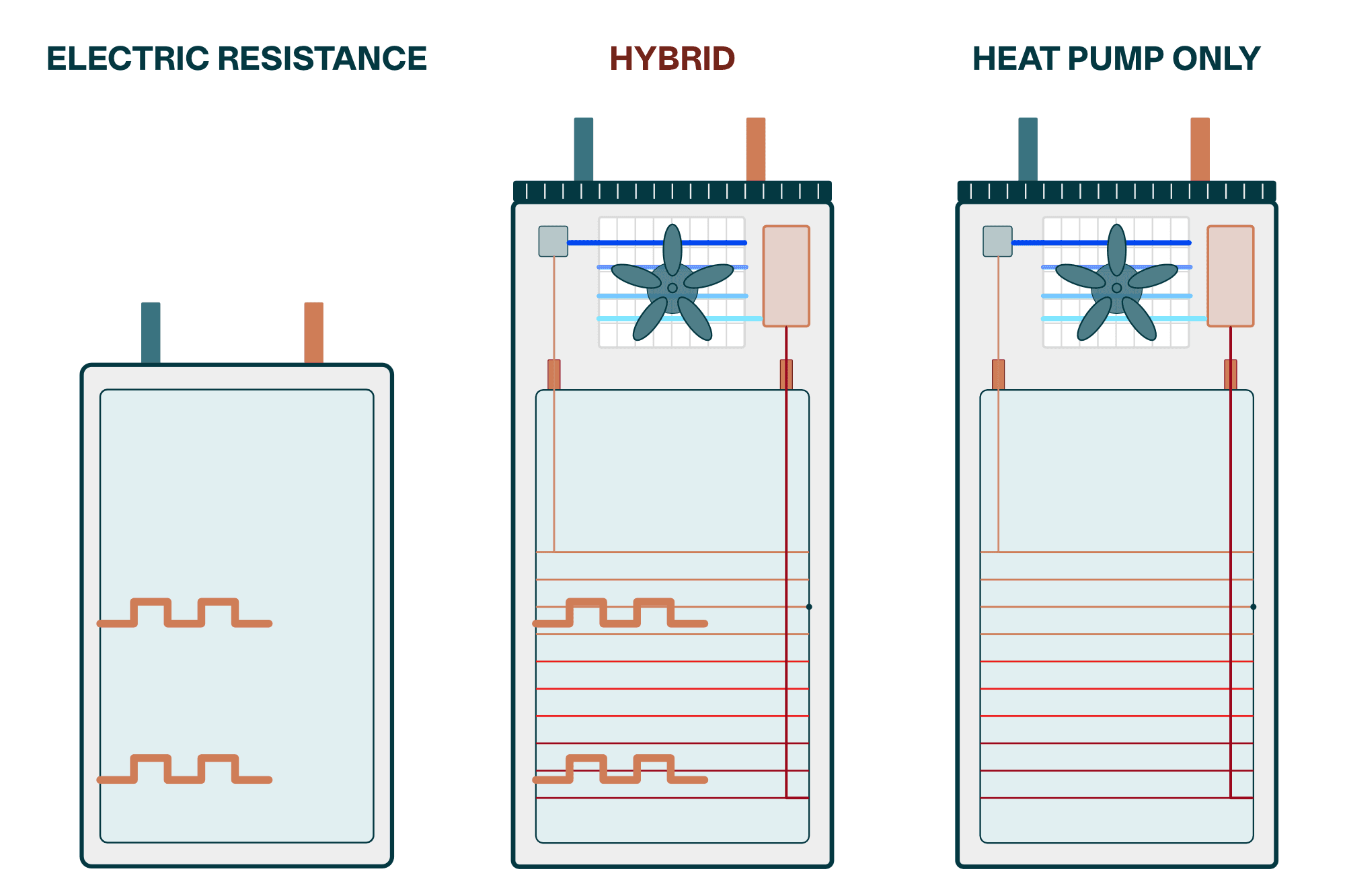
Electric resistance water heaters
An electric resistance water heater works like a kettle or a toaster: two heating elements sit inside the tank, submerged in water, and electricity flows through them until they get hot. That heat transfers directly into the surrounding water. It's simple, reliable technology, and it's been the default option in many American homes for decades. The tradeoff is that it's not as efficient as heat pump technology.
Heat pump water heaters
A heat pump water heater works like an air conditioner or a dehumidifier running in reverse: a refrigerant loop pulls warmth from the surrounding air and concentrates it into the tank. Because it's moving heat rather than creating it, it gets 3-4x the energy output of electric resistance for the same amount of energy input.
Hybrid heat pump water heaters
A hybrid heat pump water heater is a heat pump water heater with one or more electrical resistance elements added as backup. This is what Reservoir is: it gets the efficiency of a heat pump, and the ability to respond quickly to demand of electric resistance.
How much do electric water heaters cost upfront?
Electric resistance water heaters
A standard 40-50 gallon electric resistance tank typically installs for $2,000-$4,000, including the unit and labor. It's usually the cheapest option on the table, since there's no venting, no airflow requirements, no condensate, and minimal electrical work if you're replacing a like-for-like unit.
Reservoir
A Reservoir Core installs for $3,950, and a Reservoir Max for $4,950, both including the unit, labor, and energy-efficiency rebates applied directly to your quote. Reservoir handles the install process ourselves.
Other heat pump water heaters
Other HPWH brands typically install for $4,000-$9,500, depending on the brand, tank size, and whether the installation requires ducting, electrical upgrades, or a contractor visit for a full install (most non-Reservoir HPWH installs require a licensed contractor, which is reflected in the price). Costs on the higher end of that range are usually driven by installation complexity, or installer unfamiliarity with the technology, rather than the unit itself.
How much do electric water heaters cost to operate?
Electric resistance water heaters
At typical Massachusetts electric rates ($0.30/kWh) and usage for a household of four, an electric resistance tank costs roughly $120/month to run. Because it's converting electricity to heat at close to a 1:1 ratio, the cost scales directly with your electric rate.
Reservoir
A Reservoir Core or Max costs roughly $50/month to operate under the same conditions, less than half the cost of electric resistance, because it's only pulling a fraction of the electricity to produce the same amount of hot water.
Because Reservoir uses a predictive algorithm to optimize heating around a number of factors, it can attain an even higher field efficiency than its 3.53 UEF score indicates. It considers when your household typically uses hot water, whether your rooftop solar panels are producing energy, when your electric rates might be cheaper based on grid capacity, and more.
Other heat pump water heaters
Other HPWH models should land in a similar or slightly higher range, around $60/month. Because most heat pump water heaters lack intelligence and learning, in some cases their usage can approach that of an electric resistance water heater if you have higher usage concentrated at a certain time of day. Actual operating cost depends on your usage, as well as the unit's UEF rating, tank size, and installation quality (poor airflow around the unit reduces efficiency).
The no-brainer case to upgrade with 0% financing
If you have an electric resistance tank, high electric rates, and access to 0% interest financing through programs like the Mass Save HEAT Loan, switching to Reservoir could be cash-flow-positive for you immediately. Let's dive into the math.
The actual monthly cost to operate your water heater depends on how much energy it uses and the cost of that energy.
To figure out how much you're paying to heat water, you'll first need your electric rate, which you can find on your bill, and is usually listed as cents per kilowatt-hour (kWh). Then, look up the energy used by your particular water heater model. This is usually reported as energy used in a full year, so divide by 12 to get monthly electricity use. Last, multiply that monthly use by your electric rate.
With an electric resistance tank heater, you are likely paying between $60 and $140 per month for hot water, whereas with Reservoir, you will likely pay between $25 and $60 per month.
Electric rate per kWh | Electric resistance monthly fuel cost 400 kWh/mo | Reservoir monthly fuel cost 175 kWh/mo | Typical monthly fuel savings w/ Reservoir |
|---|---|---|---|
$0.15 | $60 | $26 | $34 |
$0.20 | $80 | $35 | $45 |
$0.25 | $100 | $44 | $56 |
$0.30 | $120 | $53 | $67 |
$0.35 | $140 | $61 | $79 |
Fuel usage numbers are for a typical household of four in the Boston metro area in 2026. Typical electric rates in this area are $0.30-0.35, among the highest in the country.
Depending on your electric rate, you could save between $34 and $79 on your electric bill every month by switching from an electric resistance tank to a Reservoir.
Of course, the cost of switching to a new product can’t be counted out. That’s where the financing option comes in. With a 7-year, $0 down, 0% interest loan, the $3,950 Reservoir Core can have as low as a $47/month loan payment, and a $4,940 Reservoir Max would be $59/month.
If your electric rate is… | Typical monthly fuel savings w/ Reservoir | Will you save more than the monthly price to finance a Reservoir Core? | Will you save more than the monthly price to finance a Reservoir Max? |
|---|---|---|---|
$0.15 | $34 | No | No |
$0.20 | $45 | Yes | No |
$0.25 | $56 | Yes | Maybe |
$0.30 | $67 | Yes | Yes |
$0.35 | $79 | Yes | Yes |
The upshot: if you have an electric resistance water heater and your electricity costs more than $0.25 per kWh (as it does in most places in MA), upgrading to a Reservoir starts saving you money immediately. Even including the purchase price.
Get a no-obligation quote to upgrade
Find out what you’d save by switching from electric resistance to Reservoir with our five-minute Virtual Assessment. Let us know you have an electric water heater, and we’d be happy to run the numbers for you.